
Why Sale Prices Aren't Always What They Seem
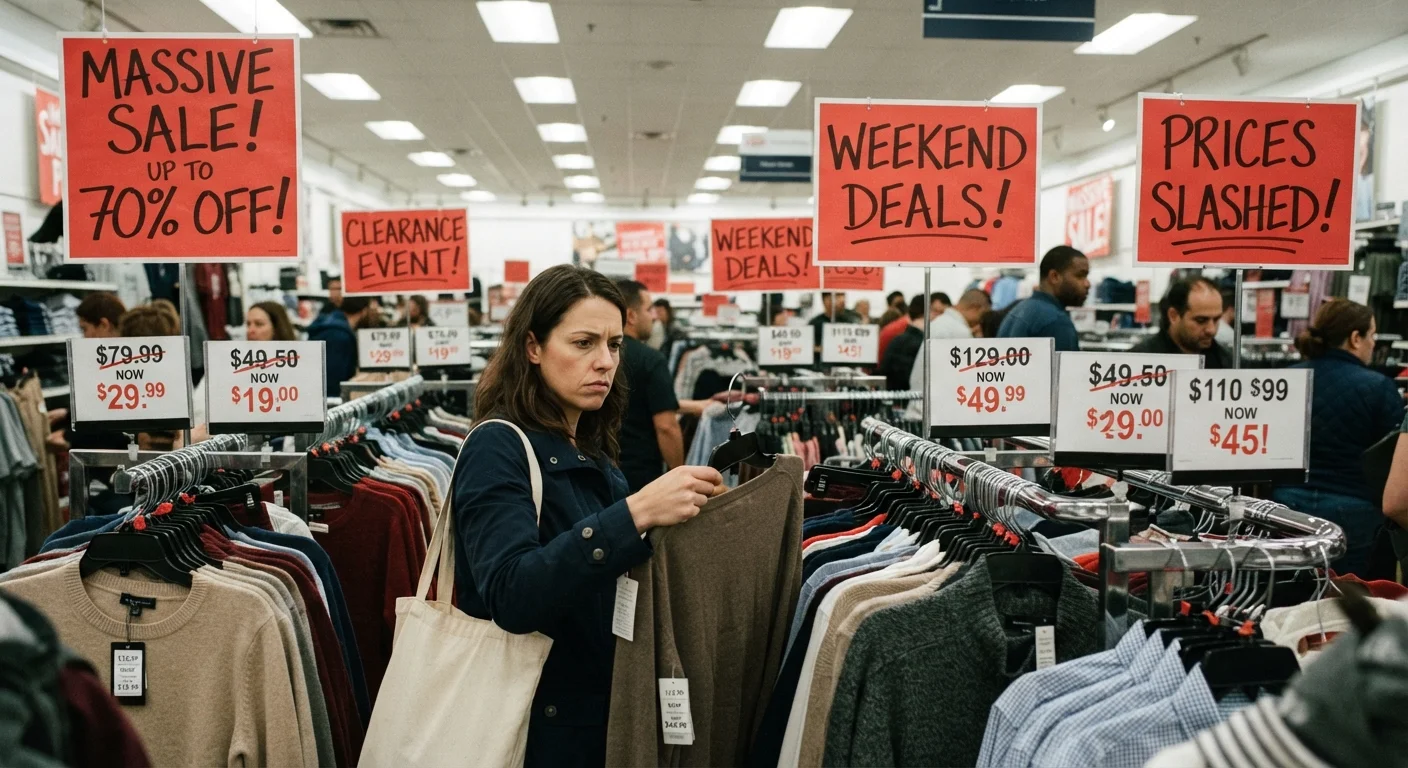
Photo credit: ResultsPivot.com | Discover Insightful Content!
In this article
Inflated 'original' prices and rolling discounts are common retail tactics. Here's how promotional pricing actually works.
Key Takeaways
- Many 'original' prices are inflated specifically to make discounts look more impressive than they are.
- Rolling sales mean some items are rarely, if ever, sold at the advertised 'regular' price.
- Comparing the sale price to competitors — not the crossed-out tag — is a more reliable value check.
- Understanding common retail pricing tactics helps you make decisions based on actual value, not manufactured urgency.
The Illusion of the Crossed-Out Price
Walk through any retailer's sale section and you'll see the same formula: a steep original price, neatly crossed out, replaced by a figure that feels like a rescue. It's compelling — and it's largely by design. Retailers have long used a pricing strategy called reference pricing, where the 'original' figure anchors your perception of value before you even register the sale number.
The problem is that reference price is sometimes set artificially high, never intended to reflect what consumers would realistically pay. Some prices are briefly listed at a higher rate — for just long enough to qualify legally as the 'regular' price — before being discounted indefinitely. The result is a permanent 'sale' that isn't really a sale at all. For more on the broader myths that shape shopping decisions, see common shopping myths that cost people money.
87%
Shoppers influenced by sale signage
A survey by the National Retail Federation found that the large majority of US consumers report sale signage influences their purchase decisions, regardless of the actual discount size.
~30%
Items never sold at 'original' price
Consumer advocacy research has estimated that a significant share of sale-tagged products in major retail environments are rarely or never purchased at the listed reference price.
Common Mistakes Shoppers Make With Sale Pricing
Knowing that promotional pricing can be misleading is one thing — recognizing how it catches you off-guard in the moment is another. The mistakes below are easy to make precisely because they feel rational. Each one exploits a genuine consumer instinct, which is why they work so consistently.
Treating the crossed-out price as a reliable baseline for value.
Why it happens: Anchoring is a well-documented cognitive bias — the first number we see shapes how we judge every number that follows. Retailers know this and structure pricing displays to exploit it.
Assuming a higher percentage discount always means a better deal.
Why it happens: A '60% off' label feels significant regardless of what the math actually produces. Shoppers often focus on the discount size rather than the final price.
Buying something primarily because it's on sale, rather than because you need it.
Why it happens: Sale framing introduces a sense of opportunity and mild scarcity — the feeling that not buying is leaving money on the table. This emotional pull can override practical judgment.
Assuming a sale is time-limited when it may be effectively permanent.
Why it happens: Urgency language — 'limited time,' 'ends soon' — is standard retail copy, used even when the promotion rolls over repeatedly. Shoppers take the deadline at face value.
Overlooking total cost by focusing only on unit price during a promotion.
Why it happens: A low per-item price feels like automatic savings, but shipping, handling, minimum purchase thresholds, or subscription commitments can erode or eliminate the discount.
Rolling Sales Are More Common Than You'd Think
Some retailers structure their promotional calendars so that certain product categories are almost always 'on sale.' If a product is discounted more often than it's full-price, the sale price is effectively the real price. Check historical pricing data when evaluating bigger purchases — a brief spike to a higher price followed by a lengthy discount period is a recognized pattern in promotional retail strategy.
How to Actually Evaluate a Deal
The most reliable way to assess a sale price is to remove the crossed-out number from the equation entirely. Instead, ask: Would I consider this price fair if I saw it without the original listed beside it? Then check what the same or comparable item costs at two or three other retailers. Price-tracking tools — available as browser extensions for online shopping — can also show you historical pricing data, making it easier to see whether a 'sale' reflects a genuine drop or a manufactured one.
It also helps to think about cost-per-use rather than sticker price. A deeply discounted item you'll rarely use isn't a better deal than a full-price item you'll rely on for years. This logic applies especially when shopping in volume — a reminder worth keeping in mind from our piece on when bulk buying genuinely saves money. For a broader framework on making value-driven purchases, the Smart Shopping hub is a useful reference point.
Your Benchmark Should Be the Market, Not the Tag
No retailer's crossed-out price should serve as your reference point for value. The only meaningful benchmark is what you'd pay for the same item — or a close equivalent — through other available channels. Build this comparison habit before purchasing, not after, and you'll sidestep the most common mechanics of promotional pricing.

Author
Shopping Editorial Team
Shopping Editorial Team is the collective byline for our editorial team and contributor network. Articles published under this byline or an editorial pen name are researched, written, and reviewed according to our editorial standards for clarity, consistency, and independence before publication.
View all articles →