
The Interleaving Effect: Learning Multiple Things at Once Can Actually Work
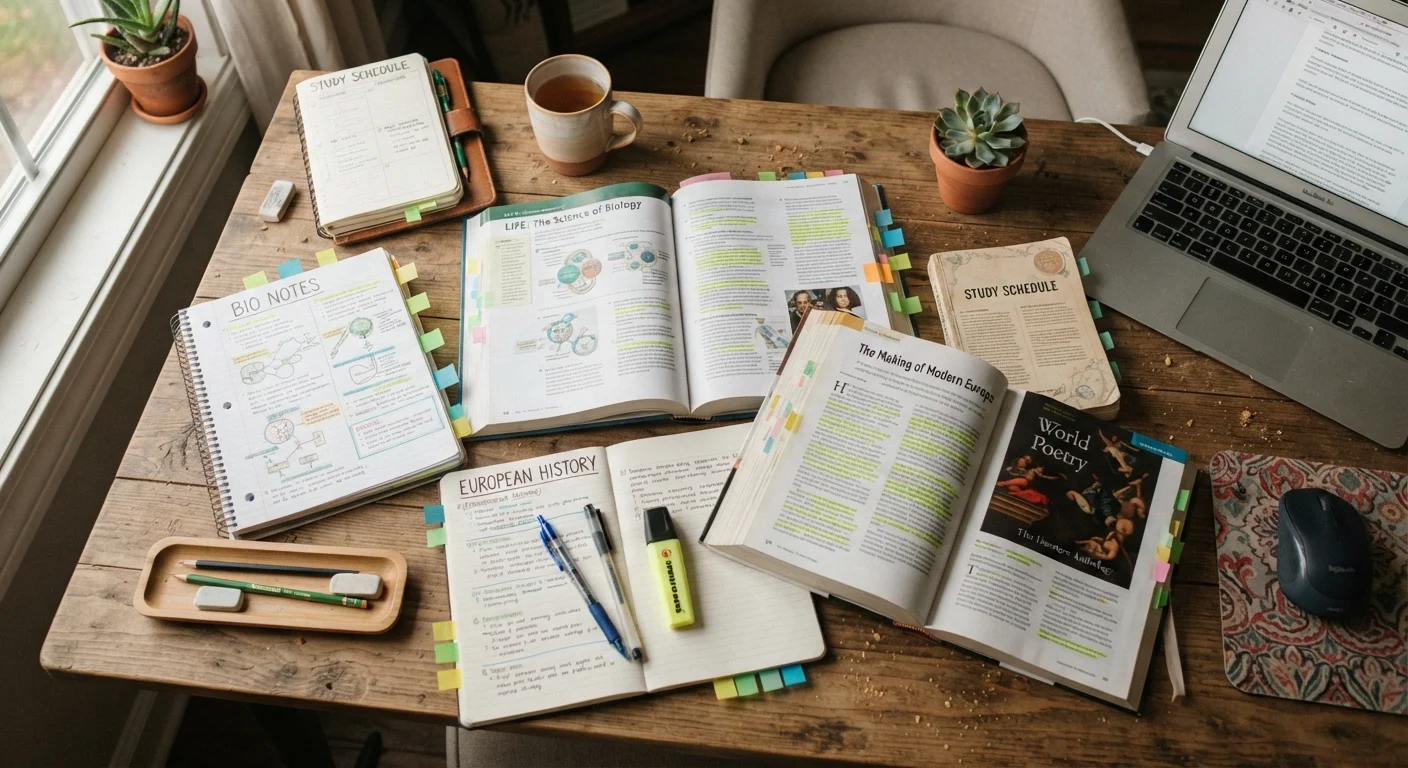
Photo credit: ResultsPivot.com | Discover Insightful Content!
In this article
Mixing topics during a study session feels harder — and that's often the point. Understand how interleaving builds deeper, more transferable knowledge.
Key Takeaways
- Interleaving means mixing topics or problem types within a session, not just spacing them across days.
- The strategy feels harder than blocked practice — that difficulty is a sign it's working.
- Interleaving builds the ability to recognize which skill or concept applies in unfamiliar situations.
- It works best after you have basic familiarity with each topic being mixed.
- Combining interleaving with spaced repetition creates a particularly powerful learning routine.
Why Blocked Practice Feels Right but Often Isn't
Most of us study the way we were taught: finish Chapter 3 completely, then move to Chapter 4. Teachers call this blocked practice — working through one topic exhaustively before touching the next. It feels logical, and it produces quick, satisfying progress on each individual unit.
The problem is that this fluency is partly an illusion. Because you've just been immersed in one topic, retrieval feels easy — but that ease reflects short-term familiarity, not lasting knowledge. When you encounter the same material a week later, or need to apply it in an unfamiliar context, much of it has faded.
If your study habits already feel off, it's worth checking our piece on signs your study habits are working against you — some of the most comfortable routines are the least effective.
~15–20%
Typical advantage of interleaved over blocked practice on delayed tests
Multiple peer-reviewed studies in cognitive psychology have found interleaved learners outperform blocked-practice learners on tests given days or weeks later, even when immediate scores favor blocked practice.
~4× more
Retrieval decisions made during interleaved versus blocked sessions
Because learners must repeatedly identify which concept applies, interleaved practice generates significantly more active retrieval attempts per session, according to educational psychology research.
What Interleaving Actually Looks Like in Practice
Interleaved practice means rotating between topics, problem types, or skills within the same study session. Instead of doing 30 algebra problems in a row, you might do 10 algebra problems, 10 geometry problems, and 10 statistics problems — cycling through them rather than clustering by type.
The same logic applies beyond math. A language learner might alternate between vocabulary, grammar drills, and listening comprehension within one session. A musician could practice three different pieces rather than perfecting one at a time. The structure looks messier but produces more durable learning.
Start Small When Introducing Interleaving
If full interleaving feels overwhelming, begin by mixing just two topics within a session before adding a third. Use a simple checklist or timer to keep rotations consistent. The discomfort eases with practice, and the long-term retention payoff becomes noticeable within a few weeks of regular use.
This connects naturally to spaced repetition, which schedules review across time. Interleaving handles what you study within a session; spaced repetition handles when you revisit it. Used together, they create a particularly robust learning routine.
The Cognitive Mechanism Behind the Effect
Why does mixing topics help? Every time you switch, your brain must stop and ask: What kind of problem is this? Which approach applies here? That identification step — deciding which tool to reach for — is itself a skill, and it's one that blocked practice never trains.
Researchers call this discrimination learning. When topics are interleaved, you're repeatedly practicing the act of categorizing and selecting strategies, not just executing them. This mirrors how knowledge gets used in the real world, where problems rarely announce which chapter they came from.
“The key to interleaving is that it forces the learner to distinguish between problem types — a skill that blocked practice systematically avoids. That discrimination is often the hardest and most important part of real understanding.”
— Robert Bjork, Distinguished Research Professor of Psychology, UCLA, and leading researcher in human memory and learning
For a deeper look at how the adult brain encodes new skills, see the science behind how adults actually learn new skills — it covers neuroplasticity and retrieval practice in plain terms.
When and How to Use Interleaving Effectively
Interleaving is not a strategy for your very first encounter with a topic. Cognitive research suggests it works best after you've built basic familiarity with each subject being mixed. Think of blocked practice as the foundation and interleaving as the structure you build on top.
One practical approach: use the first third of a study session to briefly review the basics of each topic, then spend the remaining time rotating through mixed problems or tasks. Track which switches feel hardest — those friction points often reveal exactly where deeper understanding is still needed.
Learning multiple things at once also pairs well with active engagement strategies. Our article on active learning in a digital classroom covers complementary methods for keeping your mind engaged rather than passively absorbing material.
Frequently Asked Questions

Author
Education Editorial Team
Education Editorial Team is the collective byline for our editorial team and contributor network. Articles published under this byline or an editorial pen name are researched, written, and reviewed according to our editorial standards for clarity, consistency, and independence before publication.
View all articles →