
Tracking Your Spending by Hand vs. Using an App
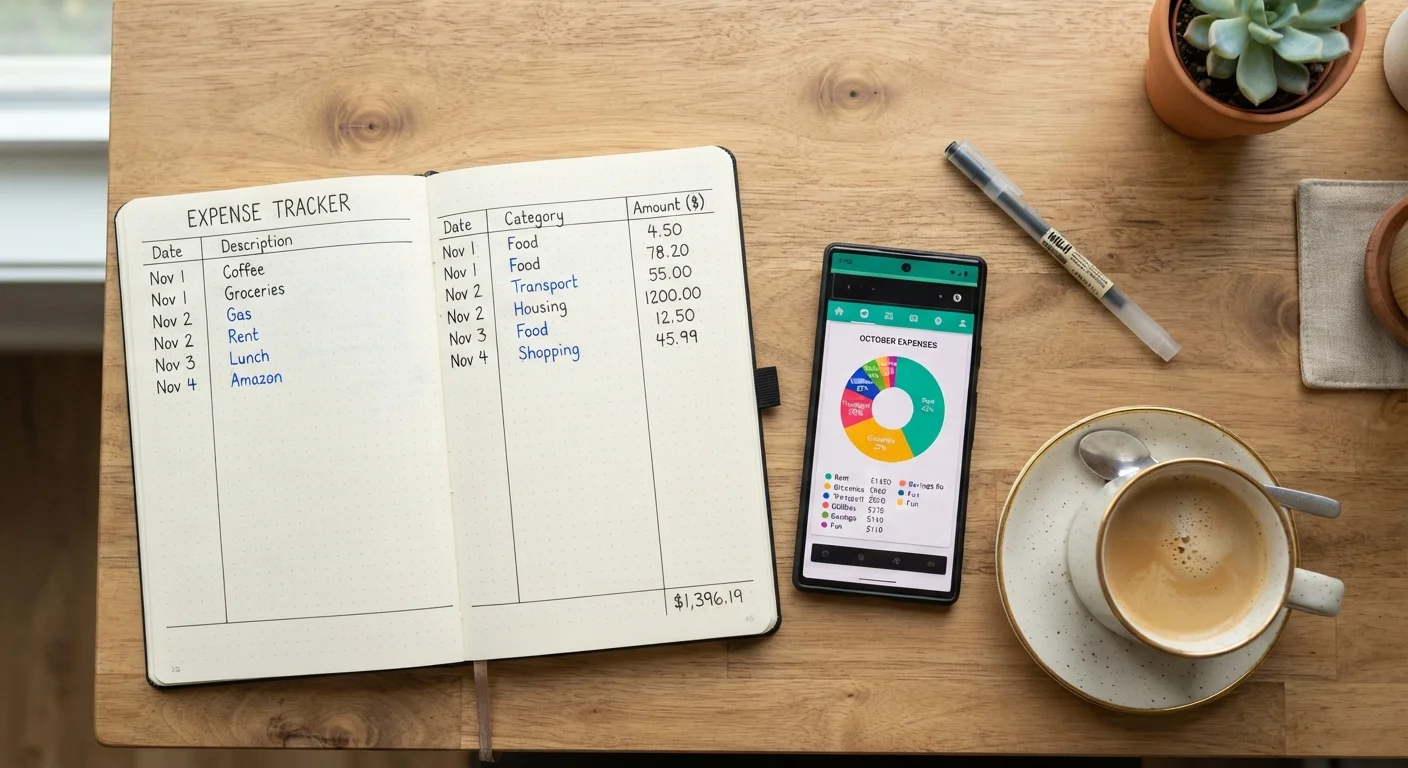
Photo credit: ResultsPivot.com | Discover Insightful Content!
In this article
Weigh the trade-offs of manual expense tracking against app-based methods, so you can choose the approach that actually fits your habits.
Key Takeaways
- Manual tracking builds stronger spending awareness through the act of writing things down.
- Budgeting apps automate data entry and offer real-time visibility into every transaction.
- Your personality and daily habits matter more than which method is objectively 'better.'
- Combining both approaches works well for many people, especially when starting out.
Builds stronger awareness through active engagement
Writing down each expense creates a moment of reflection that passive app syncing skips. Many people report feeling more accountable when they physically record what they spend.
Fully customizable to your own categories
You decide what counts as "dining out" vs. "groceries" vs. "work lunch" — no preset buckets forcing you to shoehorn your spending into someone else's framework.
No data-sharing or account-access required
Your financial information stays entirely under your control, with no third-party servers, data brokers, or connectivity requirements involved.
Zero cost and minimal tech dependency
A notebook and a pen are all you need. There's nothing to subscribe to, update, or lose access to if a service shuts down.
Easy to fall behind or miss transactions
Manual logging depends entirely on consistent habit. Miss a few days during a busy week and your record becomes unreliable, undermining the whole purpose.
Time-consuming to total and analyze
Calculating monthly category totals, spotting trends, or comparing periods all require manual arithmetic — an extra step that many people skip.
Harder to manage multiple accounts or income sources
If you have a checking account, two credit cards, and a side income, consolidating everything manually takes real effort and discipline.
No automated alerts or real-time visibility
You won't get a notification when you're nearing your dining budget. Awareness only comes when you sit down to review — which may be too late to adjust.
Why the Method You Choose Actually Matters
Tracking your spending is one of the most reliable foundations of a healthy budget — but only if you actually stick with it. The biggest predictor of success isn't whether you use a leather-bound journal or a sleek app; it's whether the method fits how you already live.
If you've ever started a budget and abandoned it after two weeks, there's a good chance the tracking method was the problem, not you. Understanding where your money actually goes starts with a system you can maintain consistently — and that looks different for everyone.
This Is About Education, Not a Prescription
The tracking method that works is the one you'll actually use consistently. There's no single right answer here — personal finance research shows that engagement and consistency matter more than the specific tool. Think of this as a framework to help you evaluate your own habits, not a directive to follow a particular approach.
Tracking by Hand: The Case for Going Analog
Writing down your purchases in a notebook or spreadsheet might sound old-fashioned, but research in behavioral finance consistently suggests that the physical act of writing reinforces memory and emotional engagement with information. When you manually log a $47 dinner or a $12 impulse buy, you feel it in a way a passive notification simply can't replicate.
Builds stronger awareness through active engagement
Writing down each expense creates a moment of reflection that passive app syncing skips. Many people report feeling more accountable when they physically record what they spend.
Fully customizable to your own categories
You decide what counts as "dining out" vs. "groceries" vs. "work lunch" — no preset buckets forcing you to shoehorn your spending into someone else's framework.
No data-sharing or account-access required
Your financial information stays entirely under your control, with no third-party servers, data brokers, or connectivity requirements involved.
Zero cost and minimal tech dependency
A notebook and a pen are all you need. There's nothing to subscribe to, update, or lose access to if a service shuts down.
Manual tracking also gives you total control over categories and layout, which matters if your spending doesn't fit neatly into an app's preset buckets. It works completely offline, costs nothing, and keeps your financial data off third-party servers — a real consideration if privacy is a concern for you.
The Downsides of Doing It by Hand
The effort required is the obvious trade-off. You have to remember to log every transaction — easy enough for a big grocery run, harder after a hectic workday when you made four small purchases. Gaps are common, and gaps in expense tracking are the financial equivalent of a blind spot.
Easy to fall behind or miss transactions
Manual logging depends entirely on consistent habit. Miss a few days during a busy week and your record becomes unreliable, undermining the whole purpose.
Time-consuming to total and analyze
Calculating monthly category totals, spotting trends, or comparing periods all require manual arithmetic — an extra step that many people skip.
Harder to manage multiple accounts or income sources
If you have a checking account, two credit cards, and a side income, consolidating everything manually takes real effort and discipline.
No automated alerts or real-time visibility
You won't get a notification when you're nearing your dining budget. Awareness only comes when you sit down to review — which may be too late to adjust.
Manual methods also make it harder to spot trends over time. Calculating monthly averages or comparing this quarter to last requires extra work. For people managing multiple accounts, cards, or income streams, that friction adds up fast.
Using an App: Convenience Has Real Value
Budgeting apps that connect to your bank and card accounts can pull in transactions automatically, categorize spending, and surface patterns you might never notice on your own — like the fact that your "small" coffee habit runs $90 a month. That kind of visibility is genuinely powerful.
~60%
Americans living paycheck to paycheck
A widely cited figure from LendingClub and PYMNTS surveys suggests roughly 60% of U.S. adults report living paycheck to paycheck, underscoring why active spending awareness — through any method — matters.
3–4x
More spending categories visible with app tracking
Users who switch from manual to app-based tracking commonly report discovering recurring charges and spending patterns they had not previously identified.
Apps also make it easier to share a budget with a partner, set spending alerts, and track progress toward savings goals in real time. If you're working through a framework like zero-based budgeting or the 50/30/20 rule, most apps can structure your categories to match.
Where Apps Fall Short
Convenience has a cost. Connecting financial accounts to a third-party app means sharing sensitive credentials or account access — a risk worth understanding before you sign up. Read the privacy policy and understand what data is stored, shared, or sold.
There's also the passivity problem. When transactions log themselves automatically, many users glance at the dashboard without truly engaging. The app does the work, but insight still requires your attention. Some people also find that app categories don't match their real-life spending patterns, leading to miscategorized data that distorts the picture.
How to Decide (or Mix Both)
Start by asking yourself: When I made my last impulsive purchase, would I have logged it that same day? If the honest answer is no, a fully manual system may frustrate you into quitting. If you dislike sharing financial account access, an app may feel more stressful than helpful.
Many people find a hybrid works well — keep a small notebook for daily logging to stay intentional, then reconcile with a simple spreadsheet or app at the end of the week. This pairs the mindfulness of manual tracking with the organizational power of digital tools.
Whatever you choose, the goal is the same: to build a monthly budget that reflects reality, not a best-case version of your spending. Once your tracking is consistent, you can take the next step and look at automating your savings to put momentum behind your goals.
This article is for general informational purposes only and does not constitute personalized financial advice. For guidance tailored to your situation, consider speaking with a qualified financial professional.

Author
Finance & Money Editorial Team
Finance & Money Editorial Team is the collective byline for our editorial team and contributor network. Articles published under this byline or an editorial pen name are researched, written, and reviewed according to our editorial standards for clarity, consistency, and independence before publication.
View all articles →