
Open Kitchens, Bar Seats, and Chef's Counters: Dining Formats Changing the Restaurant Experience
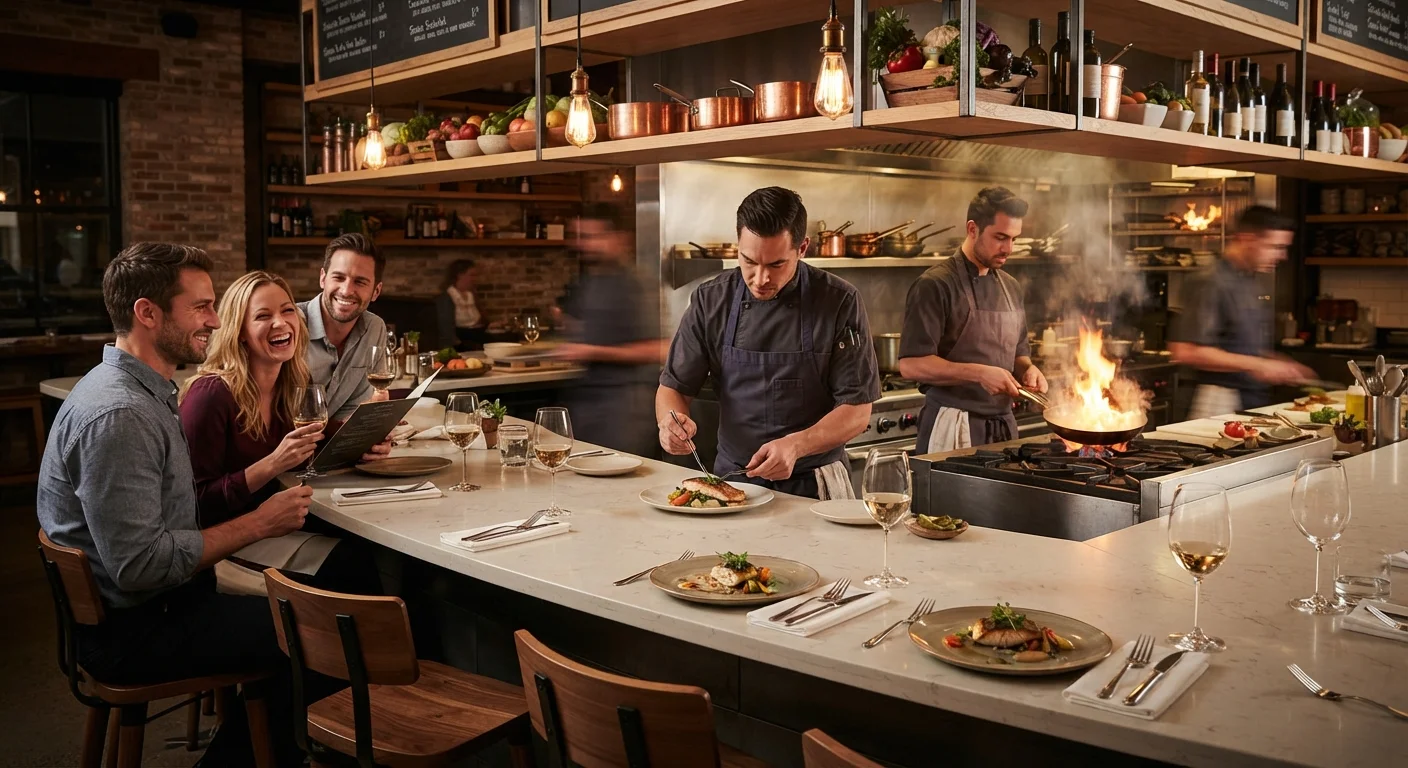
Photo credit: ResultsPivot.com | Discover Insightful Content!
The physical layout of American restaurants is changing how diners interact with food and chefs. A look at the formats redefining the dining experience.
Key Takeaways
- Open kitchens, chef's counters, and bar seats are reshaping the physical relationship between diners and chefs.
- These formats often create more intimate, interactive dining experiences than traditional table service.
- The rise of these layouts reflects broader shifts in what American diners value: transparency, spontaneity, and connection.
- Some formats, like omakase counters, cater to solo diners and food-curious enthusiasts equally.
- Restaurant design is increasingly treated as part of the dining experience itself, not just its backdrop.
The Layout Is the Experience
Walk into a restaurant from 30 years ago and you'd likely find a dining room clearly divided from a hidden kitchen. That wall — literal or figurative — is coming down. Across the US, a growing number of restaurants are rethinking their physical layouts as a core part of what they're selling, not an afterthought to the menu.
Whether it's a sprawling open kitchen behind a marble counter, a handful of coveted bar seats facing an induction burner, or a full omakase-style chef's counter where the meal unfolds in real time, these formats are fundamentally changing what it means to "go out to eat." They turn passive diners into participants, and transform chefs from behind-the-scenes workers into storytellers with a live audience.
This shift connects to bigger conversations about transparency, craftsmanship, and what people are actually seeking from a restaurant in today's evolving dining landscape. Below, we break down the formats making the biggest waves — and why they're resonating with American diners right now.
The Open Kitchen
The open kitchen — where the cooking line is fully or partially visible from the dining room — has become one of the most common architectural choices in contemporary American restaurants. What was once a novelty is now practically expected in certain dining categories.
The appeal is multifaceted. Diners get a live window into the craft behind their meal: the careful plating, the controlled chaos of service, the teamwork of a coordinated kitchen. For restaurants, visibility creates a kind of built-in accountability. When the kitchen is on display, cleanliness, organization, and technique all become part of the brand.
Open kitchens also shift the energy of a dining room. The sounds and smells that once stayed behind closed doors — sizzle, smoke, the clatter of pans — now become ambient texture, adding to the sense that something exciting is happening.
When the kitchen is on display, the cooking itself becomes part of the dining room's energy.
Chef's Counter and Omakase Seating
Chef's counter dining takes open-kitchen visibility one step further: guests sit directly across from the person preparing their food. In its most formal iteration — particularly in Japanese-influenced omakase restaurants — a single chef or small team serves a fixed, often surprise-driven menu to just a handful of diners at a time.
This format has exploded in popularity across US cities in recent years, spreading well beyond sushi bars into contexts ranging from Italian tasting menus to modern American cuisine. The intimacy of the format is a large part of its draw. Conversation flows naturally between chefs and guests; questions get answered in real time; the pacing of the meal becomes a collaborative rhythm.
Chef's counters also serve the growing solo dining community particularly well. A single seat at a counter carries none of the awkwardness that can accompany a lone diner at a large table — it feels purposeful and connected rather than isolated.
Omakase-style counters have spread well beyond sushi bars, redefining intimacy in American dining.
Bar Seats Facing the Action
Not every restaurant can accommodate a full chef's counter, but many are carving out prime bar seating positioned to give diners a direct view of the cooking. These seats — often just a handful, tucked against a pass or surrounding an open prep station — have become some of the most sought-after reservations in the business.
Part of the appeal is spontaneity. Bar seats tend to lend themselves to a looser, more improvisational dining experience. Servers and cooks are physically close, making it easier to ask about the food, request something off-menu, or simply get a feel for the restaurant's personality. For food-curious diners, this is often exactly what they're after.
These seats also attract a different kind of visit than a formal dinner reservation — a quick lunch, a solo meal after work, or a deliberate choice to eat lightly and experimentally rather than committing to a full tasting experience.
A bar seat facing the kitchen often delivers a looser, more adventurous dining experience than a formal table.
Communal and Shared Table Formats
Some restaurants are pulling the camera back even further — away from individual tables and toward shared, communal dining arrangements where guests may sit alongside strangers. Long tables, bench seating, and family-style service all contribute to an environment where the social dimension of eating is foregrounded.
This format connects food to community in a deliberate way. It's less about individual service and more about the collective experience of a meal — which is, of course, how humans have eaten throughout most of history. Communal tables are making a genuine comeback in American restaurants, driven partly by a desire for connection that goes beyond the meal itself.
These arrangements work especially well in casual and mid-range restaurants, where the social lubricant of a relaxed atmosphere makes proximity to strangers feel welcoming rather than intrusive.
Communal tables foreground the social dimension of eating — which is, historically, the whole point.
Counter-Service and Fast-Casual with Visibility Baked In
It's not only high-end restaurants embracing transparency through design. Counter-service and fast-casual formats — where guests order at a counter and sometimes watch their food assembled in front of them — have baked visibility into their model from the start. The difference is that these formats make it structural and scalable.
Watching a sandwich being built to order, or observing a grain bowl being composed with precision, carries a similar psychological satisfaction to watching a chef plate a tasting-menu course. It signals freshness, customization, and care — all things that diners increasingly value.
This is one reason why the line between fast casual and fine dining continues to blur. The design philosophies are converging around a shared principle: show the diner what's happening, and let the food speak for itself. That's a long way from the hidden kitchens of a previous era — and it's a shift most American diners seem enthusiastic about.
Fast casual's built-in transparency has quietly influenced how fine dining thinks about visibility too.
What This Means for the Future of Eating Out
These formats aren't a passing trend — they reflect a genuine recalibration of what diners expect from a restaurant visit. People are increasingly drawn to experiences that feel considered, transparent, and worth their time and money. A meal at a chef's counter or a well-designed open kitchen delivers on all of that in ways a standard four-top often can't.
Making the Most of Counter and Bar Seating
If you're curious about counter or chef's table dining, it helps to arrive with an open attitude toward timing and pacing — these seats often follow the kitchen's rhythm more than a fixed schedule. Don't hesitate to ask questions; chefs and cooks working an open station generally enjoy the conversation. Booking a counter seat solo or as a pair tends to be much easier than snagging a larger table at the same restaurant.
It's also worth noting what these formats do for the industry itself. When the kitchen is visible, the stakes are higher — and that pressure tends to sharpen both cooking and service. Restaurants designed around these concepts often signal a serious commitment to craft.
As dining culture continues to evolve, the physical space of a restaurant is becoming as much a part of the conversation as the food on the plate. Curious about how all of this connects to broader food trends shaping American eating? The appetite for these experiences shows no signs of slowing down.
A Contrast Worth Noting
These visibility-forward formats stand in sharp contrast to the ghost kitchen model, where there's no front-of-house presence at all — just a delivery bag and an app. Ghost kitchens represent the opposite extreme: maximum efficiency, minimum theater. The fact that both models are thriving simultaneously says a lot about how diverse American dining preferences have become.

Author
Food & Drink Editorial Team
Food & Drink Editorial Team is the collective byline for our editorial team and contributor network. Articles published under this byline or an editorial pen name are researched, written, and reviewed according to our editorial standards for clarity, consistency, and independence before publication.
View all articles →