
Zones, Labels, and Flow: The Principles That Make Any Room Stay Tidy
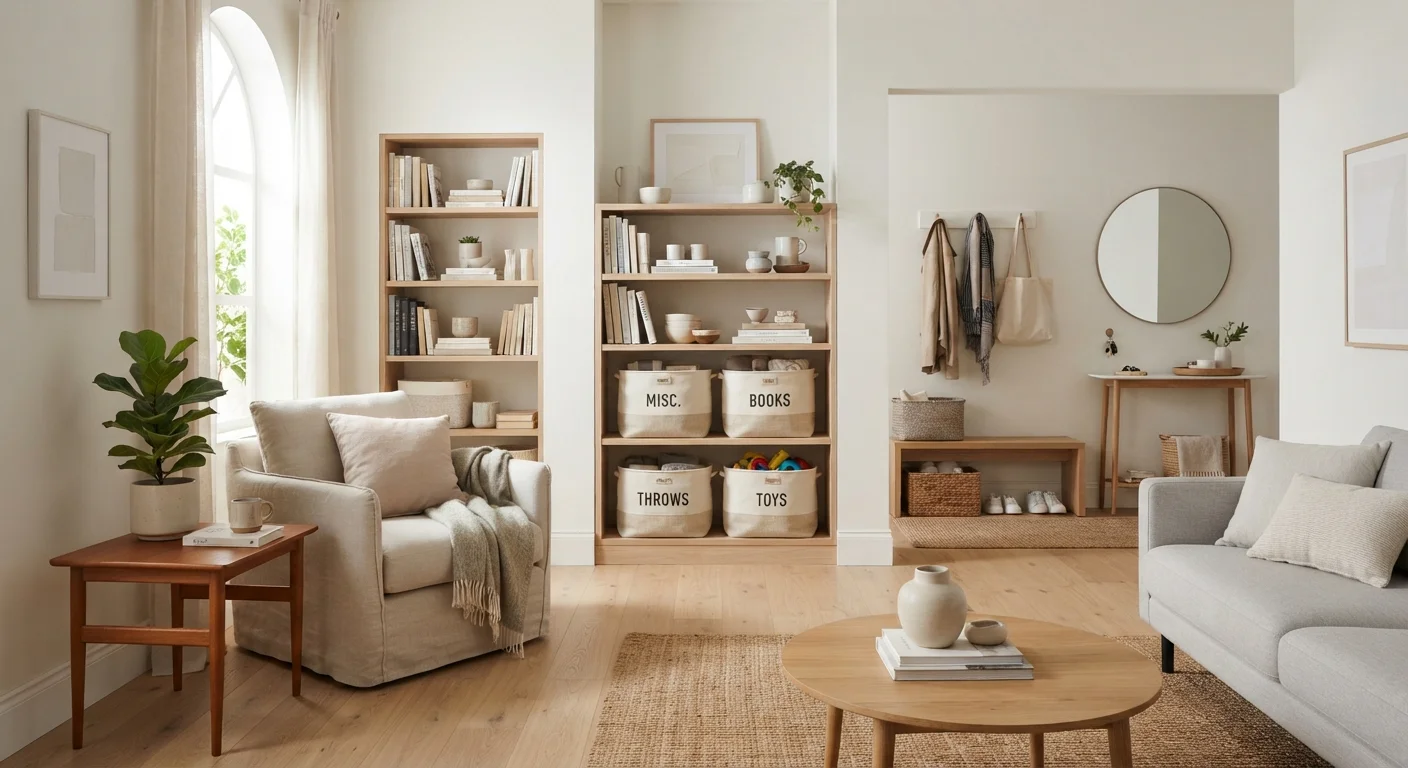
Photo credit: ResultsPivot.com | Discover Insightful Content!
In this article
Good organisation isn't about aesthetics — it's about how a space functions. Learn the core principles that make tidiness stick long-term.
Key Takeaways
- Defining activity zones before buying storage prevents mismatches between how you live and how your space is set up.
- Labeling isn't just for aesthetics — it reduces decision fatigue and makes systems self-maintaining for everyone in the household.
- Flow, meaning how naturally items return to their home, determines whether a tidy room stays that way or reverts to chaos.
- Most tidiness failures are system failures, not habit failures — the fix is structural, not motivational.
- You don't need a full overhaul; applying even one principle consistently creates measurable, lasting improvement.
Why Systems Fail (And What to Do Instead)
Most rooms don't stay tidy because the tidying system was designed for how the space looks, not how it's actually used. Baskets are purchased before zones are mapped. Labels are applied but ignored. Storage gets optimized for a visitor's eye, not a weekday brain. The result: a room that looks organized for about a week, then quietly reverts.
The three principles — zones, labels, and flow — aren't aesthetic tools. They're functional ones. Applied together, they account for real human behavior: the mental load of decision-making, the tendency to default to the nearest flat surface, and the reality that multiple people use the same space differently. If you've been frustrated by tidiness that doesn't stick, the problem is almost certainly the system, not your habits.
Zones: Map How You Actually Use the Room
A zone is a designated area where one category of activity happens — and where everything related to that activity lives. Before assigning storage, spend a few days observing where behavior naturally clusters. Where do keys land? Where does homework get done? Where does the mail pile up?
Zoning means working with those tendencies, not against them. If backpacks always end up by the front door, that's where the backpack zone belongs — not in a mudroom hallway nobody actually walks through. Forcing items to a location that doesn't match natural movement creates friction, and friction kills systems.
Map zones based on observed behavior, not ideal behavior.
People default to habits under cognitive load, so a system designed around idealized movement will be abandoned quickly. Observing where activity actually clusters before assigning storage prevents mismatches from the start.
Assign every item to exactly one zone — and stick to it.
Ambiguity about where something belongs is the source of most surface clutter. When an item has one defined home, the question of where it goes is never re-litigated.
Keep zone boundaries visible and logical, especially in multi-use rooms.
Without clear boundaries, zones bleed into each other and lose function. A visible cue — a rug, a shelf unit, or even a change in container style — makes a zone legible without requiring anyone to memorize a rule.
Use specific labels rather than broad catch-all categories.
Broad labels like 'stuff' or 'misc' recreate the same ambiguity that causes clutter. Specific labels guide decision-making automatically and make it obvious when something is in the wrong spot.
Design return paths to require the fewest possible steps.
The harder it is to return something to its home, the more likely it is to be left out. Reducing physical and cognitive effort for the return path is the single most effective way to maintain tidiness without willpower.
For rooms that need to serve multiple purposes, overlap is fine as long as transitions are clear. A dining table that doubles as a homework station can work if each zone has its own defined storage spot nearby. The key is that every item belongs to a zone, and every zone has a logical boundary. Need to start from scratch? Our beginner's guide to organising a home walks through the full process.
Labels: Make the System Legible to Everyone
Labels serve a purpose beyond aesthetics: they externalize memory and reduce the mental effort of maintaining order. When a bin is labeled, no one has to remember which drawer holds the batteries or decide whether scissors go back with the office supplies or the craft materials. The decision is already made.
Label for the Whole Household
If you're the only one who knows the system, you'll be the only one maintaining it. When adding labels, run them by everyone who uses the space — including kids — to confirm the categories make sense to them. A label that resonates with all users gets respected by all users. Simple, readable fonts and consistent placement (always on the front, always at eye level) also help labels do their job without requiring a tutorial.
For shared households, legibility is especially important. A system only one person understands is a system only one person will maintain. Labels should be simple, specific, and placed at eye level — or lid level if items are stored in stacked bins. Broad categories like "misc" defeat the purpose; specific ones like "charging cables" or "kids' art supplies" stick.
Labels also function as a maintenance checkpoint. When something doesn't fit the label, that's a signal the zone needs adjusting — not that the item needs to be crammed in anyway. This feedback loop is what keeps systems current over time.
40%
Time spent searching for misplaced items
Research from the National Association of Productivity and Organizing Professionals suggests Americans spend a significant portion of their day looking for things they own but can't locate.
1 in 4
US homeowners with a cluttered garage
A widely cited survey by the National Association of Home Builders found that a quarter of homeowners with two-car garages can't fit even one car inside due to stored items.
Flow: Design for How Things Return, Not Just Where They Go
Flow is the least talked-about principle, but it's often the deciding factor between a system that holds and one that collapses. Flow describes how easily — and how naturally — an item finds its way back to its designated spot after being used.
High-friction return paths are the most common cause of clutter. If something requires opening a cabinet, moving another item, and then closing the cabinet again, most people won't do it consistently. Especially not at 10 p.m. on a Tuesday. Low-friction alternatives — an open bin, a hook instead of a hanger, a shelf at arm height — reduce the activation cost of tidying to nearly zero.
“Organization is not about perfection; it's about efficiency, reducing stress and clutter, saving time and money, and improving your overall quality of life.”
— Christina Scalise, Author and professional organizer
Audit your room's flow by asking: what's on surfaces that shouldn't be? Those items are typically signal that their designated home has too many steps to reach. Repositioning or simplifying storage for those items almost always solves it faster than forming a new habit. For the daily routines that reinforce good flow, see small daily habits that keep a home feeling calm.
Putting It Together: Quick Ways to Start
You don't need a weekend overhaul. Each principle can be applied incrementally, room by room. A good starting point is to pick the one space that causes the most daily friction — usually a kitchen, entryway, or living room — and run it through all three lenses: Are zones defined by actual behavior? Are storage spots labeled specifically enough? Is the return path for the most-used items genuinely low-effort?
If you want to work through your home more systematically, the room-by-room decluttering checklist is a practical companion to these principles. And if you're curious how popular organizing philosophies like KonMari or FIFO compare as frameworks, this comparison breaks them down clearly. The principles of zones, labels, and flow apply across all of them.

Author
Home & Living Editorial Team
Home & Living Editorial Team is the collective byline for our editorial team and contributor network. Articles published under this byline or an editorial pen name are researched, written, and reviewed according to our editorial standards for clarity, consistency, and independence before publication.
View all articles →