
The Science Behind Why Cats Knock Things Off Tables
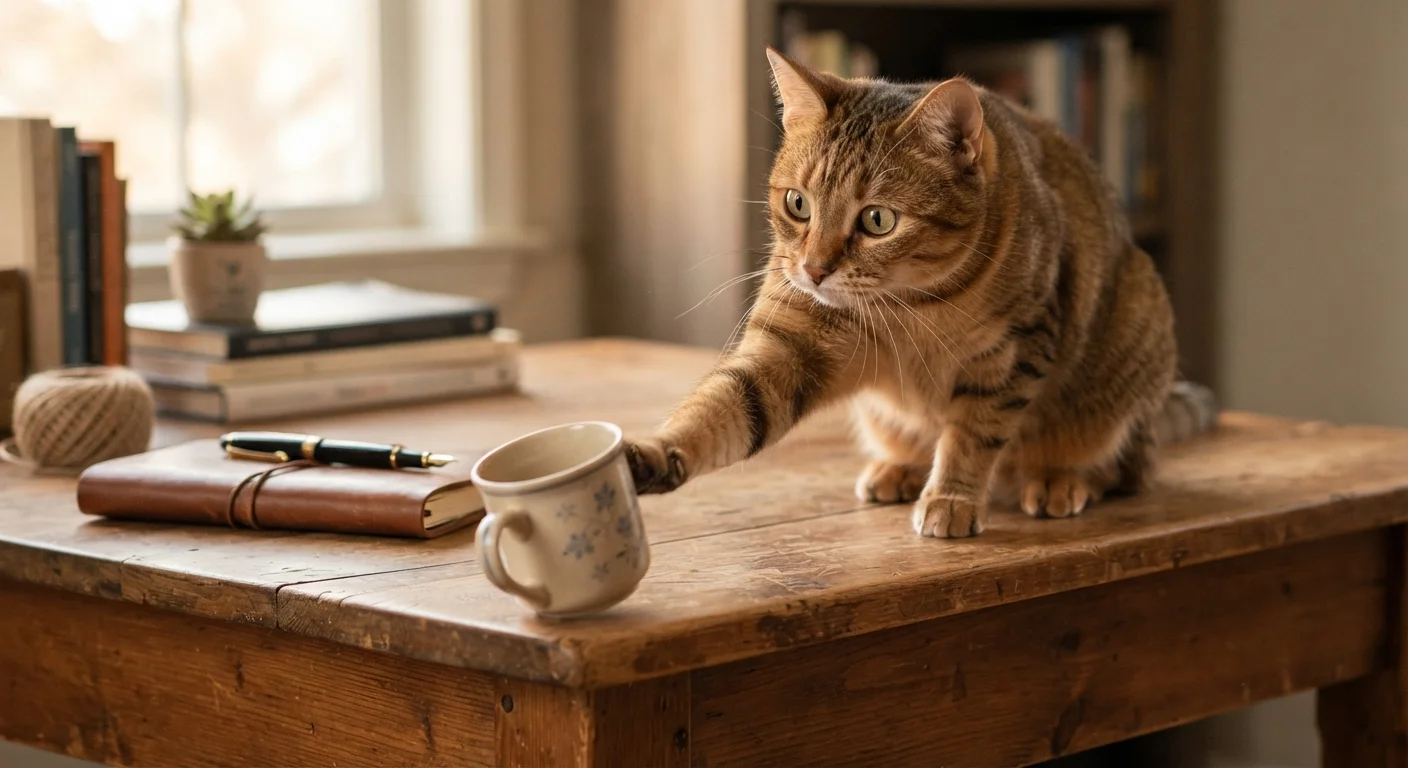
Photo credit: ResultsPivot.com | Discover Insightful Content!
It's not spite — feline object-dropping has real behavioural roots. Here's what researchers and vets think is going on.
Key Takeaways
- Cats knock objects off surfaces primarily out of curiosity and predatory instinct, not spite.
- The behavior often intensifies when cats are understimulated or seeking attention.
- Redirecting the behavior with enrichment is more effective than punishment.
- Understanding feline instincts helps owners respond calmly and constructively.
Why Do Cats Do This, Anyway?
If you've ever watched your cat lock eyes with you, slowly extend one paw, and deliberately swipe your coffee mug off the counter — you've probably wondered what on earth is going on in that fuzzy head. Is it meanness? Boredom? Some kind of power play?
The short answer: it's complicated, but it's also completely normal. Cats are natural hunters, and much of what looks like inexplicable behavior to us is actually deeply rooted in feline instinct and sensory curiosity. This is also part of a much broader picture — as we explore in our guide to behaviours that seem odd but are completely normal in pets, a lot of quirky cat habits have perfectly logical explanations once you understand how cats experience the world.
Below, we break down the most common myths about this behavior — and what's actually going on.
Myth
Cats knock things over out of spite or to punish their owners.
Fact
Cats do not experience spite the way humans do. The behavior is driven by instinct and environmental factors, not revenge.
It's tempting to interpret that deliberate swipe as a message — "You were gone too long, and now your glass pays the price." But feline cognition doesn't work that way. Cats lack the complex theory of mind required to plan petty retaliation. What looks like spite is almost always a combination of curiosity, boredom, or learned attention-seeking. When a behavior gets a big human reaction, cats quickly learn it's an effective way to get engagement — not because they're plotting, but because they're adaptive.
Myth
It's random, meaningless behavior with no purpose.
Fact
Object-dropping is closely linked to cats' hardwired predatory instincts and their drive to test and explore their environment.
In the wild, cats use their paws to investigate potential prey — batting at something to check whether it's alive, how it moves, and whether it poses any risk. Domestic cats retain this behavior even when the "prey" is a pen or a decorative candle. The movement of a falling object also mimics the erratic motion of small prey, which triggers further interest. Far from meaningless, it's a form of environmental investigation that's deeply embedded in feline neurology.
Myth
Only bored or neglected cats do this.
Fact
Even well-stimulated, well-loved cats knock things over — enrichment reduces frequency but doesn't eliminate the instinct entirely.
Boredom and under-stimulation can certainly amplify the behavior, but attributing it solely to neglect misses the bigger picture. Even cats in enriched, attentive homes will occasionally clear a surface — it's part of normal exploratory behavior. That said, if it's happening constantly and intensifying, it may be worth reviewing your cat's daily enrichment and play routine, since persistent object-batting can signal unmet mental or physical needs.
Myth
Cats do it because they want to make a loud noise or cause destruction.
Fact
Cats are primarily responding to the tactile feedback and movement of objects, not the noise or damage they cause.
Cats' paws are remarkably sensitive sensory organs, packed with nerve receptors. When a cat taps an object, it's gathering information — texture, weight, how easily it moves. The crash that follows is largely incidental from the cat's perspective. However, if your reaction to the noise is loud and animated, they may come to associate the sound with getting your attention, which can reinforce the behavior over time. The sensory experience of the tap itself, not the aftermath, is the primary motivator.
What You Can Actually Do About It
Knowing the "why" is empowering, but most owners want practical solutions too. The good news: this behavior is manageable with a few smart adjustments.
~73%
Cat owners report object-knocking behavior
Informal surveys by veterinary behavior organizations suggest the majority of cat owners observe this behavior at least occasionally in their pets.
2–3x
More likely in under-enriched indoor cats
Feline behaviorists generally note that cats lacking adequate daily play and mental stimulation show significantly higher rates of attention-seeking behaviors.
Increase active enrichment. Cats that have consistent outlets for their predatory instincts — think wand toys, puzzle feeders, or window perches with bird feeders outside — are less likely to go hunting for stimulation on your bookshelves. For indoor cats especially, structured play sessions make a measurable difference. Our article on indoor vs. outdoor lifestyles for cats explores why enrichment is so central to indoor cat wellbeing.
Don't reward the attention-seeking loop. If your cat pushes something off a shelf and you immediately react — even with a frustrated "no!" — you've handed them exactly what they wanted. Calmly redirect to an appropriate activity instead.
Secure valuables, not your cat's curiosity. Rather than trying to suppress an instinct entirely, work with it. Designate a shelf or tray with cat-safe objects they're allowed to interact with. Cats communicate a lot through physical interaction with their environment — something our field guide to feline communication digs into further.
Avoid Punishment-Based Responses
Scolding, spraying with water, or making loud noises to deter the behavior can increase anxiety in cats without addressing the underlying cause. Stress-related behaviors can escalate if a cat feels unsafe or unpredictably punished. Positive redirection and environmental adjustments are consistently recommended by veterinary behaviorists as the more effective — and kinder — approach.
With a little patience and the right setup, the shelf-clearing antics can become much less frequent — and maybe even a little more charming.

Author
Pets Editorial Team
Pets Editorial Team is the collective byline for our editorial team and contributor network. Articles published under this byline or an editorial pen name are researched, written, and reviewed according to our editorial standards for clarity, consistency, and independence before publication.
View all articles →